

Abstract
This essay describes the successes and challenges of skills-based literature survey courses in the small liberal arts college setting of Westminster College (New Wilmington, PA). It considers the overall purpose of the survey in the skills-based English curriculum and then focuses on the integration of literary theory and creative writing as means of developing student skills and meeting program objectives.
In his 1993 essay, “Connecting Literature to Students’ Lives,” Dan Morgan lamented that survey courses tend to be perceived by both faculty and students as “necessary but unpleasant burdens” (494). Some twenty years later, we are still searching for approaches that would make these courses more meaningful and valuable to our students. How can we create a survey experience in which students’ engagement with literature is less perfunctory and more genuine? For faculty teaching at under-enrolled liberal arts colleges, this question is particularly concerning, given the survey’s potential for attracting and retaining students. After all, a good survey experience has the power to reaffirm a student’s choice of the English major, to entice a non-major to join the program, or to turn a student away from critical reading and writing altogether.
I teach at Westminster College (New Wilmington, Pa.), a small, undergraduate liberal arts institution where English faculty approach the teaching of introductory survey courses in the same way we approach the teaching of the senior capstone course: collaboratively and creatively, with an emphasis on student-centered instruction. Throughout the past decade, in an effort to keep English studies relevant to a shrinking pool of students, we have shifted our survey (and overall program) outcomes away from the acquisition of content and toward the development of skills. This shift evolved from faculty conversations that began in the early 2000s, when, according to Westminster Professor Bethany Hicok, “we stopped thinking that American and British literature could be ‘covered’ and that our students could be ‘filled’ with these texts” (42). “Instead,” Hicok writes, “we invited our students to talk to us, to each other, and to the texts they were reading” (42). More recently, we have begun to focus survey course design more intentionally on skills-based outcomes, which primarily concern areas of critical reading, critical and creative writing, and scholarly conversation. Our survey sequence consists of two courses: ENG 240 introduces key texts in British literature, while ENG 250 focuses on American literature. Each course introduces and requires students to begin applying theoretical approaches, including New Criticism, feminism, Marxism, and psychoanalytic criticism (ENG 240) and structuralism, postcolonialism, African-American Criticism, and New Historicism (ENG 250). We offer two sections of ENG 240 every fall, and two sections of ENG 250 every spring. Each section is taught by a different faculty member, which facilitates faculty collaboration in the design and implementation of the syllabus and major course assignments.
In its existing configuration, each of our modified surveys requires heavy multitasking of both teachers and students, riddled as it is with a number of goals. As the gateway to the major, the survey is at once an introduction to British or American literary tradition, an overview of theoretical perspectives, and a fine-tuning of the reading, writing, and thinking skills students are acquainted with in freshman writing and liberal arts education courses. English faculty know that, in the context of the literature survey, efficiency is at once a strength and a downfall.1 For English faculty at Westminster, preparing students to succeed on the varied assignments I describe in the following pages requires significant collaboration and a great deal of class time, which ultimately means that we read fewer pieces of literature and spend less time on historical and cultural context. But because our curriculum places the student in the role of the scholar from the start, we are as invested in cultivating students’ capacities for critical thinking, writing, and speaking about texts as we are in developing their understanding of literary history and tradition. According to Hicok, “the Westminster College English program envisions its undergraduates as scholars from the beginning by placing scholarly conversation, rather than content, at the center of its curriculum” (42). Since the surveys represent students’ introduction to our English major and minor, we view them as essential skill-building courses, which, ideally, have the potential to attract and retain students.
While the benefits of collaborative approaches to teaching the literature survey have been explored by English teacher-scholars (Olson and Williams 200), the successes and challenges of skills-based, student-centered literature survey courses have not. Accordingly, my primary purpose here is to present the motives, methods, obstacles, and benefits associated with skills-based approaches to teaching the British and American literature survey courses in a small liberal arts college setting. To do so, I will first take a brief look at traditional survey course function in the context of Westminster’s peer institutions’ curricula. Then, I will describe how and why my colleagues and I have modified that design by integrating literary theory and developing innovative, skills-based assignments. I will conclude with a brief discussion of individual and institutional challenges to teaching the survey course in the current climate of the small liberal arts college.
The Function of the Small College Survey, Traditional and Modified
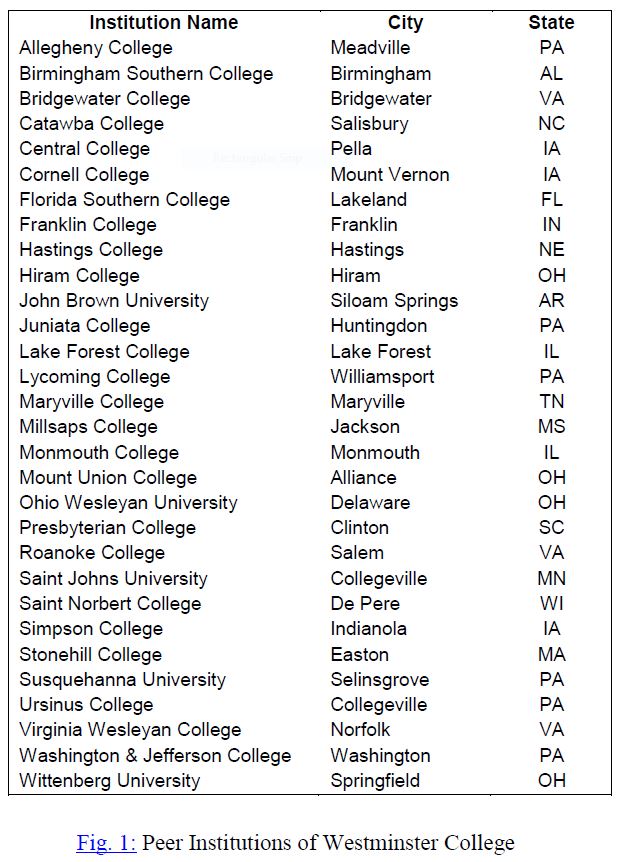
In his study of survey courses’ origins and proliferation, Ted Underwood notes that Frederick Denison Maurice designed the first period survey courses at King’s College, London, in the early 1840s, with the goal of giving “present-day students an empathic connection to some particular part of the national past” (9, 63). For better or for worse, Maurice’s method of “periodized literary education,” which Underwood cogently explores, “continues to organize modern-day departments of English” (9). Westminster College and its peer institutions are no exception to this method of organization. An investigation of Westminster’s peer institutions’ (see Fig. 1) English programs reveals that, generally, survey courses tend to fall into the curricula in one of two patterns: 1) They are spread into four or more 200-level courses—the standard being two British and two American, sometimes with one or more World Literature, Irish Literature, and/or African American Literature surveys. These courses are preceded by a 100-level Introduction to Literary Study course that develops students’ skills in close reading and literary analysis, and they are often followed by a 400-level Literary Theory course. 2) Traditional survey courses are not present at all, but are replaced by genre-specific courses that likely integrate some survey content, e.g., Introduction to Fiction; Introduction to Poetry, etc. Not unexpectedly, the majority of curricula I investigated follow pattern 1.
But there are outliers. Consider, for example, the English programs at Juniata College and Central College. At Juniata, students take 100-level courses titled “Forms of Literature” and “Critical Perspectives,” followed by a selection of topically themed, and, in some cases, nation-specific surveys at the 200-level, including “Unnatural Acts” and “Bloody Murder,” both of
Fig. 1: Peer Institutions of Westminster College which focus on American literature (“English: Curriculum”). At Central College, students take a 100-level “Introduction to the Literary Imagination” course, followed by a set of traditional British and American literature survey courses, the first of which—British Literature I—not only introduces literary theory but also requires students to integrate it into course papers (“English: Policies…”).2 Regardless of how or where it falls into the curriculum, the function of the survey is clear: it is an efficient way to give students the foundation in literary history that they need to become informed readers of texts (Olson and Williams 219).
Like the English curriculum at Central College, Westminster’s modified survey courses intersect with traditional survey offerings in that we offer a set of specific courses devoted to British and American literary traditions. Since we operate on a four-credit course system, however, our students tend to take fewer courses than students of three-credit course institutions like Central. Consequently, we are tasked with designing our curriculum in a way that synthesizes the delivery of literary content with the facilitation of student skill development. Our current program does this across a set of ten required courses: Students begin the major with the two 200-level modified surveys, followed by two 300-level Studies in Context courses (e.g., Shakespeare, Modernism, World Fiction, Best Sellers), two 400-level seminar courses (e.g., Narrative Theory, Feminisms, Tragedy), one additional 300 or 400-level course, an internship, and two 600-level capstone courses.3 Our modified surveys, then, provide an even more abbreviated view of literary history than traditional surveys not only because we offer just two of them but also because we add several components, literary theory and creative writing, which we develop later in the major. We make a concerted effort to balance our curriculum’s literary content, however, by using upper-level courses to make up for lost ground. In ENG 240, we tend to spend little time on Renaissance literature; consequently, we offer regular courses in Shakespeare and his contemporaries at the 300 and 400 levels. We sacrifice breadth for depth by teaching only Books 1 and 9 of Paradise Lost, which gives us time to explore that text from feminist and New Critical perspectives. In ENG 250, we tend to spend little to no time studying late 20th- and 21st-century poetry, so we offer a 300-level course in Contemporary American Poetry. Moreover, since our modified surveys cover only British and American canonical literature, we supplement them with a 300-level World Fiction course. In sum, we approach curriculum design in the same collaborative way that we shape our modified surveys, with six full-time English faculty collectively contributing to the coherence of the program and its courses.
According to Rebecca Olson and Tara Williams, collaborative approaches to the literature survey can “reshape its central contributions to the English major in ways that would be difficult or impossible to replicate with a single instructor” (200). We have witnessed this effect at Westminster, where our small community of English faculty collaborates on varying levels at both the beginning and the end of our major course sequence—in the teaching of the 200-level modified surveys and the 600-level capstone courses. The two faculty who teach ENG 240 to new majors in the fall of the freshman year will teach those same students ENG 601: Capstone I in the spring of their junior year, followed by ENG 602: Capstone II in the fall of the senior year. This design helps maintain student-faculty relationships and creates an intellectual community in which students can grow together across their four years at Westminster. Typically, the two Westminster professors who are teaching the modified survey in the same semester share a syllabus, though the readings differ slightly due to faculty preference and course scheduling. The two sections also share writing assignments and approximate due dates, which facilitates faculty discussion about grading and student progress. On a weekly basis, faculty share teaching resources, lecture notes, and in-class activities, but each professor ultimately determines her or his section format. In my classes, for instance, I incorporate in-class workshops for all major critical and creative writing assignments. In short, on the spectrum of collaborative teaching, our survey courses are far from being fully collaborative; it is our 600-level capstone courses that operate on a fully team-taught model to cultivate an inclusive teaching and learning community among faculty and senior student scholars.
In Spring 2016, however, due to small class sizes and scheduling opportunities, we heightened our level of collaboration in the American survey course to include regular team-taught sessions. Together, Distinguished Professor Richard Sprow and I coordinated the majority of reading assignments, co-developed all writing assignments, selected a common novel to read at the end of the course, and team-taught sixteen class sessions throughout the semester—primarily, sessions in which we were introducing or continuing discussion of a new theoretical perspective, or viewing and engaging in discussion about film. This team-teaching experience was a first for literature survey courses at Westminster. It required that we offer both sections of the course at the same time on the same day, which we had avoided in the past in an effort to accommodate student schedules. During our combined sessions, we met in the larger of our two classrooms and held collaborative lectures and large-group discussions. For some students, these classes felt “disjointed,” mostly due to my colleague’s and my own different teaching styles. For the majority of students, however, the combined sessions resulted in more “interesting,” “lively” “engaging” and “interactive” discussions that, in one student’s words, “enhanced [her] thinking about the readings” (Spring 2016). These student comments reinforce the views of Olson and Williams, who remark that team teaching has the potential to energize a course because it encourages “the generation of more ideas and of more exciting and innovative course content” (214). Overall, feedback from students, combined with faculty reflection, suggests that our decision to increase faculty collaboration in Spring 2016 resulted in an enhanced learning community for students and teachers alike.
Paradoxically, the presence of an additional faculty member in the classroom enhanced our abilities to deliver course content in a student-centered fashion. According to Morgan, student-centered teaching approaches are characterized by “an eclectic, flexible pedagogy that responds to students as individuals and to specific group dynamics” (495).4 The format of our course, combined with our different areas of expertise in American literature and our planned, yet unscripted lectures meant that the course was grounded in an eclectic literary pedagogy. Moreover, following the first three or so of our combined sessions, we were able to better understand and meet the needs of students in our separate sections. Individual student personalities became knowable in a way they would not have been able to without the combined sessions, since some initially quiet students began contributing more to their individual section discussions following the larger group meetings.
Prioritizing Student Skill Development: Strategies and Benefits
Conducting large and small group discussions on a regular basis helps us address one of our major program outcomes, which is for students to be able to discuss literature, engaging in an exchange of ideas and offering and supporting insights (See Appendix 1 for a complete list of outcomes). We target other outcomes throughout the semester by incorporating reading, writing, and presentation assignments that give students tools for success. That is, these assignments are built upon specific course concepts that we have studied together (e.g., the value of reader-oriented critical approaches to Thoreau’s Walden); yet, they are designed to offer students a number of choices that require independent critical thinking and initiative (e.g., what happens to our understanding of American Transcendentalist texts when we combine a reader-oriented critical approach with another critical approach?). Through these assignments, our courses progress according to Grant Wiggins and Jay McTighe’s concept of “backward design,” in which “the best designs derive backward from the learnings sought” (14). Because they lie outside the parameters of the majority of peer institutions’ survey courses I investigated earlier, the assignments I will focus on below have to do with literary theory and creative writing.
The notion of teaching literary theory in the undergraduate English classroom raises several important questions: When should we do it? And how can we do it in a way that is student-centered? Answers to these questions have long been debated by scholars, including Robert Scholes (Textual Power: Literary Theory and the Teaching of English, 1985), Gerald Graff (Beyond the Culture Wars: How Teaching the Conflicts Can Revitalize American Education, 1992), and Vincent Leitch (Theory Matters, 2003). I agree with Scholes that “our job [as teachers] is not to produce ‘readings’ for our students but to give them the tools for producing their own” (24), for it is this act of empowering students that creates the student-centered literature classroom. As for when we should introduce theory, it seems that earlier is better, for two main reasons. First, students need help developing good questions. As Heather Johnson points out, undergraduates new to literary studies often begin “with two basic questions: ‘Is it good?’ (which really translates to ‘Do I like it?’) and ‘What does it mean?’ (which really translates to “What is the single, simple intended message?’)” (51-52). Studying theory can help students elaborate on these basic thoughts in ways that can produce more complex, focused questions. Second, students need time to let theoretical ideas percolate. Incorporating theory into a lower-level course gives students the distance they need from the introduction of a theoretical concept to the gradual, (ideally) deepening comprehension and application of it. In Johnson’s words, “undergraduates, especially, often have trouble accepting their own intellectual authority, and may cling slavishly to the particulars of a given theory, producing the ‘cookie cutter’ readings with which we are all familiar. Giving the ideas time to settle and sort can help free students from the theorist’s authoritative, heavy presence” (47). Thus, introducing theory earlier and reinforcing it gradually is more likely to instill confidence within students.
Our incorporation of theory into the modified survey at Westminster is fundamental, in that we use Charles Bressler’s Literary Criticism: An Introduction to Theory and Practice (Pearson, 2011), which presents to students the critical histories, key terms, and central figures associated with theoretical perspectives in an accessible, condensed form. Alongside the Norton anthologies, this book offers a great starting point for the major, though it is not without its problems. Like many theory readers, this one encourages what Andrew Campbell calls “nominalization,” an “à la carte” presentation of synopses of major theoretical perspectives that can generate artificial divides among perspectives, and, in the process, encourage students to become “passive recipients of information” (135-36, 156). We tackle this problem through student-centered assignment design. In ENG 240 and 250, students complete five analytical writing assignments: three take-home quizzes, in which we pose three or so short essay questions, most of which require students to define and apply a narrow aspect of theory to an assigned course text (e.g., “explore the concept of the Other in Melville’s Benito Cereno); and two four-to-five page essays, in which students select one theoretical approach (Essay 1) or combine several approaches (Essay 2) to offer an interpretation of a course text. For the final, students work in small groups to select, contextualize, and interpret a literary text we have not read for class and “teach” it to the rest of the group, combining their choice of two to three critical perspectives. Faculty ensure that all major literary periods are covered by this presentation assignment and that all students are assigned to read each group’s text in preparation for discussion on the day of the final.
None of these assignments—presentation, essays, or quizzes—requires secondary source integration beyond Bressler and the occasional Norton author or period introduction. We want students to begin developing their own critical voices in the survey courses, so we strongly discourage the use of additional outside source material. This means that ENG 240 students writing a feminist interpretation of Jane Eyre do not read The Madwoman in the Attic itself; they only read Bressler’s summary of it. Later, perhaps in the 300-level Victorians course, and certainly in the 400-level Feminisms course, English majors have opportunities to read Gilbert and Gubar. At the survey level, however, we find the Bressler-type text sufficient. With its sample student essays and helpful bulleted lists of questions at end of each chapter, Bressler’s text unquestionably gives students tools for success—in fact, it may give them too many. But providing students with such “cognitive supports” in introductory courses helps us to “scaffold” their metacognitive processes, as Susan Ambrose’s research suggests (215); and such scaffolding is essential if we are to expect greater autonomy of our students as they progress through the curriculum. By the end of the semester in ENG 240 and 250, via the Essay 2 and final presentation assignments, we are requiring students to come up with their own questions. This exercise, Johnson explains, “puts students in a position to become theorists themselves rather than just passive recorders of historical theory” (54). According to Morgan, such active participation characterizes the student-centered survey course, since it creates a learning atmosphere that “empower[s] the students to draw conclusions, comment, disagree, [and] genuinely respond to the literature studied” (495). In this way, introducing theory helps students develop skills in critical thinking, informed speaking, and analytical writing.
My sense of skills-based reading, speaking, and writing assignments is informed by Barbara Walvoord’s suggestion that, in any given course, faculty should construct one or more major assignments “that will both teach and test” course outcomes (83). Though Walvoord refers specifically to writing assignments, her argument follows Wiggins and McTighe’s broader concept of backward design, which applies to a variety of assessable activities and assignments.
In ENG 250, the major assignments we use to teach and test course outcomes are Essay 2 and the final presentation, both described above, along with the creative writing assignment.5 Our creative writing assignment changes every few years according to the novel we adopt for the course. When we taught Chopin’s The Awakening, for example, students wrote a screenplay adaptation of a brief passage from that novel. More recently, they did the same for Egan’s A Visit from the Goon Squad. This assignment worked well for several reasons. We prefaced it with a visit from one of our film studies professors, who gave an overview on the art of screenwriting, led students through practice exercises, and provided them with web resources for searching and reading model screenplays. Neither Chopin’s nor Egan’s novel had been adapted into a definitive film version, which maximized students’ potential imaginative choices. Finally, for both assignments, students accompanied their creative work with an analysis of their writing choices. This helped us gauge their level of understanding of the novel and the cultural context in which it is set.
Creative writing is essential to the English curriculum at Westminster, since our seniors’ culminating capstone project requires both critical and creative writing components. To prepare students for the senior capstone experience, we incorporate small but significant creative writing assignments throughout each course in our curriculum. In Spring 2016, Professor Sprow and I developed a creative assignment related to E.L. Doctorow’s novel Ragtime, which we had adopted as the required novel for ENG 250 (See Appendix 2 for the assignment description). This assignment stands out in our minds—and, according to course evaluations, in students’ minds as well—as the most “innovative course content” to arise from our collaboration (Olson and Williams 214). Since Ragtime had already been adapted into an award-winning film, the screenplay assignment no longer seemed like the best option. Instead, we asked students to identify and research an American historical figure whose lifespan intersects with the first two decades of the 20th century, roughly the period in which Ragtime is set. Next, students were to select a brief section—a page, or even a single paragraph—of Ragtime to emulate and/or develop in their own 3-page (minimum) work of short fiction. Like the screenplay assignments, this one also required students to write a brief, 1-2 page analysis that justified their creative choices. Considered together, the creative work and accompanying analysis helped us evaluate students’ progress on several course outcomes, including students’ abilities to produce creative writing that shows an awareness of language, freedom from cliché, and an understanding of genre, style, and topic; and their abilities to understand the historical and cultural contexts of literature and theoretical methods of reading. The assignment effectively taught creative and critical writing skills, since imitation, according to Donna Gorrell, “offers a way for unskilled writers to learn form and structure while generating and finding expression for their own ideas” (54). It taught students more about New Historicism and reader-oriented theories than we ever could have via readings or discussions; and it tested students’ abilities to write and think critically about the ways in which enduring issues or concepts—e.g., racism, immigration, crime, music, celebrity—affect human character, then and now. This assignment was student-centered in that it required students to address and elaborate upon a series of tough questions: What historical figure would they integrate? Where? How? Why?
Such questions, combined with most students’ insecurities about and inexperience with creative writing, meant that students needed more help starting this assignment than others; still, in the interests of skill-building, I devoted one full class session to a hybrid, in-class writing workshop for each of our major writing assignments. In preparation for these sessions, students were to upload a partial draft of the assignment to a discussion thread I had created on our course website at D2L (Desire to Learn) and bring their laptops to class. At the beginning of class, I assigned students to read several peers’ partial drafts, giving them specific focus questions and discouraging them from making any sentence-level suggestions. In the Essay 2 workshop, for example, the first focus question required students to study how (if at all) each peer’s thesis statement rose above the level of observation to that of analysis. In the creative assignment workshop, one of the focus questions asked students to identify a small section of each peer’s partial draft that piqued their curiosity, due to writing style or content (or both), and explain why. As students finished reading an assigned peer’s draft, they posted responses to these and other focus questions, and I did the same—though I also posted a copy of each student’s draft with my brief, yet pointed marginal comments inserted throughout. This meant that I only had time to begin reading drafts during class and had to finish them later that day or the next. It also meant that my comments on students’ drafts were public, viewable by all students in the class. In the last fifteen or so minutes of each session, we stopped reading and talked about the strengths and weaknesses we had observed in each other’s writing. I always sought to end class by displaying a good example from one of the drafts I had read during that session—a strong topic sentence, an insightful thesis, or a well-integrated quotation—and asking students to evaluate its effectiveness.
According to student feedback, these workshops were “helpful” overall (Spring 2016). In my view, the workshops were valuable but challenging, simply because of the time required to comment meaningfully on student drafts. As Walvoord and Anderson point out, though, “comments on drafts or works in progress are likely to be more worthwhile than extensive comments on final work” (103). Faculty time, they continue, is thus better spent guiding than grading (104). I have learned to require that students incorporate into their final drafts a brief paragraph specifically explaining how and where they revised their work based on their peers’ or my workshop suggestions. This paragraph is useful to students and is a time-saver for me.
The Literature Survey in the 21st Century: Institutional and Cultural Challenges
While the use of faculty and student time presents ongoing challenges to skills-based survey course delivery, it is not as significant a problem as the ongoing shortage of English majors and minors. At Westminster, our modified surveys, like most courses across the major, are currently under-enrolled. We recently opened the surveys to students across disciplines for general education credit, but, to date, we have attracted only a handful of non-majors. This is likely because survey courses compete with our more popular, 100-level interdisciplinary “cluster” courses, which not only satisfy the College’s cluster requirement but also tend to offer general education credits for two courses, since enrolled students take two related classes in different disciplines during the same semester. Examples of currently running clusters include English 156: Literature and Medicine paired with Biology 114: The Cell Biology of Human Disease; and English 107: Detective Fiction paired with Science 150: Introduction to Forensic Science.
Our plight to attract and hold student interest is not new, nor is it specific to small liberal arts colleges. Morgan was teaching at Scott Community College (Davenport, IA) in 1993 when he observed that “most students in our freshman and sophomore literature classes are not practiced or even receptive readers, and see the required survey courses as hoops to jump through on their way to graduation with degrees in other, more ‘practical’ majors” (493). His point still resonates, and it raises an important question about the relationship between survey design and delivery and the value of literary studies in the 21st century: By decreasing the amount of literary readings and shifting survey course pedagogy away from literary content and toward students’ development of reading, thinking, writing, and speaking skills, have we somehow “sold out” to the tensions of the market, tensions which have repeatedly demanded real-world, practical application for arts and humanities courses? I do not think so. As we strive to balance breadth with depth, our resulting modified survey courses in fact recall the original purposes of literary study as it existed during its early institutionalization in mid-nineteenth-century England. According to Underwood, in the 1820s, literary study was viewed as a means of strengthening skills in writing and rhetoric, and, by the 1840s, it was considered a means of understanding past peoples and cultures (9, 64). We know that literary study in the twenty-first century continues to serve both of these purposes, and many more.
It is my hope that students in my survey courses will emerge from them caring more about literary history than they did at the beginning of the term. I hope to help them develop an appreciation of how literature can help them understand, with great complexity, what it means to be human. But I also hope for students to discover how courses in literary studies can help them become deeper thinkers, careful readers, thoughtful speakers, and practiced writers— since these, after all, are the very qualities desired by just about any employer whose job they might apply for upon graduation. With a combination of faculty guidance and innovative assignments, students can discover the potential for courses like the literature survey to become what one non-major describes as a “fun learning experience” in which, another student writes, “[my] mind and thinking ability are deeply enriched” (Spring 2015). In this student-centered literature classroom, students’ developing critical and creative voices, and their interpretive choices concerning the literature we are reading, become the sources of inspiration and the motives for success.
Appendix
See original for Appendix material (Original)
Notes
1 For an exploration of the problem of efficiency, see Randy Laist’s “The Self-Deconstructing Canon: Teaching the Survey Course without Perpetuating Hegemony” in Currents in Teaching and Learning 1 (2009): 50-57.
2 My research into peer institutions’ surveys consisted of reading department websites and course catalog descriptions; I did not view course syllabi. Accordingly, my remarks here are limited in depth.
3 English majors at Central College, for example, take twelve 3-credit courses (“English: Policies…”).
4 In addition to Morgan, Mary-Jane Eisen explores the reciprocal relationship between collaborative teaching and student-centered learning in her essay, “The Many Faces of Team-Teaching and Learning: An Overview” in New Directions for Adult and Continuing Education (2000.87): 5-14, 2000.
5 We include a creative writing assignment in ENG 240 as well, but it differs from year to year. One pair of faculty members regularly assigns a sonnet, while others give students four or five options. For example, students can craft a modern, yet Swiftian “Modest Proposal;” fill a gap they see in Shelley’s Frankenstein or Shaw’s Mrs. Warren’s Profession; or use one or more theoretical perspectives—New Criticism, Marxism, Feminism, Psychoanalytic criticism—as inspiration for an original short story or poem.
Works Cited
Ambrose, Susan A., et al. How Learning Works: Seven Research-Based Principles for Smart
Teaching. Jossey-Bass, 2010.
Campbell, Andrew. “Teaching Literary Theory to Undergraduates: What Have We Learned?”
English, vol. 46, no. 185, January 1997, pp. 131-59.
“English: Curriculum.” Juniata College. n.d. Web. 27 May 2016.
“English: Policies / Course Descriptions.” Central College. n.d. Web. 27 May 2016.
Gorrell, Donna. “Freedom to Write—Through Imitation.” Journal of Basic Writing, vol. 6, no.
2, Fall 1987, pp. 53-59.
Hicok, Bethany. “Inviting Our Students to Join the Scholarly Conversation.” Reading, Writing, and Research: Undergraduate Students as Scholars in Literary Studies. Ed. Laura Behling. Council on Undergraduate Research, 2009. 42-52.
Johnson, Heather G.S. “Violating Pedagogy: Literary Theory in the 21st-Century Classroom.”
The CEA Forum, Summer/Fall 2015, pp. 37-74.
Morgan, Dan. “Connecting Literature to Students’ Lives.” College English, vol. 55, no. 5,
September 1993, pp. 491-500.
Olson, Rebecca, and Tara Williams. “Reimagining the Literature Survey through Team
Teaching.” Pedagogy, vol. 14, issue 2, Spring 2014, pp. 199-223.
Scholes, Robert. Textual Power: Literary Theory and the Teaching of English. Yale U P, 1985.
Spring 2015 Course Evaluations. ENG 250.02: Westminster College, New Wilmington, PA.
Spring 2016 Mid-Semester Survey. ENG 250.02: Westminster College, New Wilmington, PA.
Underwood, Ted. Why Literary Periods Mattered: Historical Contrast and the Prestige of
English Studies. Stanford U P, 2013.
Walvoord, Barbara E. Assessing and Improving Student Writing in College: A Guide for
Institutions, General Education, Departments, and Classrooms. Jossey-Bass, 2014.
– – – , and Virginia Johnson Anderson. Effective Grading: A Tool for Learning and Assessment in
College: Tools for Assessment. 2nd ed. Jossey-Bass, 2010.
Wiggins, Grant, and Jay McTighe. Understanding by Design. 2nd ed. Pearson, 2006.

